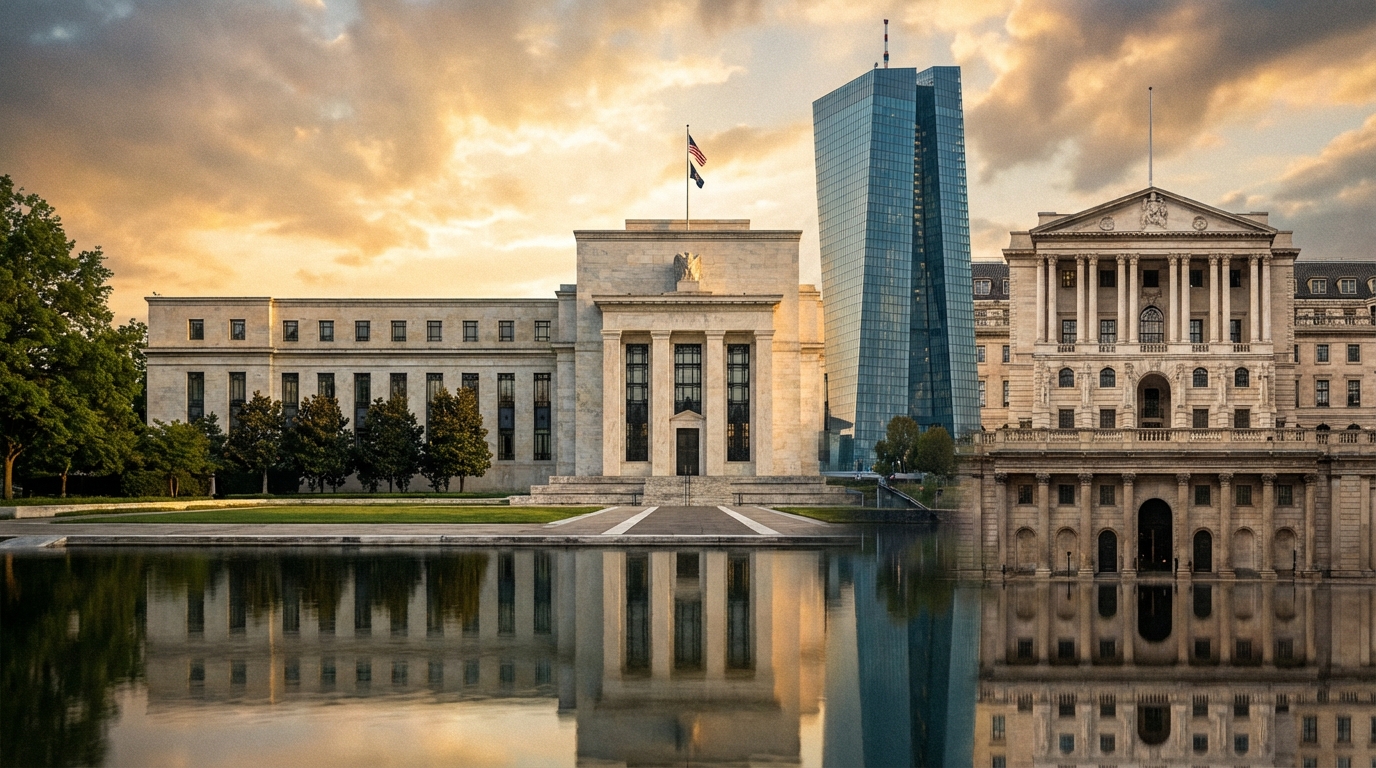

Central banks are the foundational pillars of modern financial systems, wielding immense power over economies and, by extension, global currency markets. For anyone involved in forex trading, understanding these institutions is not merely beneficial; it is essential. Their mandates, policies, and actions directly influence interest rates, money supply, inflation, and economic growth, all of which are critical drivers of currency valuations.
This comprehensive guide delves into the world of central banking, exploring their fundamental roles, examining the specifics of major central banks, and elucidating precisely how their decisions reverberate across the foreign exchange market.
The Role of Central Banks
At their core, central banks are independent public institutions responsible for managing a nation's currency, money supply, and credit conditions. While their specific mandates can vary slightly by country, their overarching goals generally revolve around maintaining economic stability and fostering sustainable growth. They are distinct from commercial banks, which serve individual and corporate clients; central banks serve the government and the banking system itself.
Primary Mandates and Objectives
- Price Stability: This is arguably the most common and critical mandate. Central banks aim to keep inflation at a low and stable level, typically targeting an annual inflation rate of around 2%. High inflation erodes purchasing power, while deflation can stifle economic activity.
- Maximum Sustainable Employment: Some central banks, notably the U.S. Federal Reserve, operate under a "dual mandate" that includes promoting maximum employment alongside price stability. This involves fostering conditions conducive to job creation and low unemployment.
- Financial Stability: Central banks act as a "lender of last resort" to commercial banks, providing liquidity during times of crisis to prevent systemic collapse. They also often oversee banking regulations and payment systems to ensure the smooth functioning of the financial sector.
- Currency Issuance: Central banks are typically the sole issuer of a nation's currency, managing its supply and integrity.
- Economic Growth: While often a secondary objective, central bank policies indirectly support economic growth by creating a stable environment conducive to investment and consumption.
Key Monetary Policy Tools
To achieve their mandates, central banks employ a range of monetary policy tools:
- Policy Interest Rates: This is the most widely recognized tool. By adjusting the benchmark interest rate (e.g., the Federal Funds Rate, ECB's Deposit Facility Rate, BoE's Bank Rate), central banks influence the cost of borrowing for commercial banks, which in turn affects interest rates throughout the economy. Higher rates tend to curb inflation and cool an overheating economy, while lower rates stimulate borrowing, investment, and growth.
- Open Market Operations (OMOs): Central banks buy or sell government securities in the open market to inject or withdraw liquidity from the banking system, thereby influencing short-term interest rates and the money supply.
- Quantitative Easing (QE) and Quantitative Tightening (QT): During periods of severe economic stress or very low interest rates, central banks may resort to QE, large-scale asset purchases (typically government bonds or mortgage-backed securities) to inject liquidity and lower long-term interest rates. QT is the reverse process, reducing the central bank's balance sheet to withdraw liquidity.
- Forward Guidance: Central banks communicate their future policy intentions to guide market expectations and influence long-term interest rates and economic behavior.
- Reserve Requirements: The percentage of deposits that commercial banks must hold in reserve, though this tool is less frequently adjusted in developed economies today.
- Foreign Exchange Interventions: In specific circumstances, a central bank might directly buy or sell its currency in the forex market to influence its exchange rate, often to stabilize it or counter excessive volatility.
Key Takeaway: Central banks are the architects of monetary policy, using a suite of tools to manage inflation, employment, and financial stability. Their actions are paramount in shaping the economic landscape and, consequently, currency valuations.
Federal Reserve (Fed)
The Federal Reserve, often simply called "the Fed," is the central bank of the United States. Established in 1913, it plays a critical role in both the domestic and global financial systems due to the U.S. dollar's status as the world's primary reserve currency.
Mandate and Structure
The Fed operates under a dual mandate from Congress: to achieve maximum employment and maintain price stability. It also has responsibilities for financial stability and regulating banking institutions.
Its structure is unique, combining centralized government agency elements with decentralized regional banks:
- Board of Governors: Seven governors appointed by the President and confirmed by the Senate, based in Washington D.C., overseeing the entire system.
- Federal Open Market Committee (FOMC): The primary monetary policy-making body, consisting of the seven governors, the president of the Federal Reserve Bank of New York, and presidents of four other Federal Reserve Banks on a rotating basis. The FOMC sets the target range for the federal funds rate.
- 12 Federal Reserve Banks: Located in major U.S. cities, these banks provide services to commercial banks and the U.S. Treasury, and they conduct economic research.
Key Tools and Influence
The FOMC's primary tool is the adjustment of the federal funds rate target range. This is the rate at which commercial banks lend reserves to each other overnight, influencing other short-term interest rates throughout the economy. The Fed also utilizes tools such as the discount rate, reserve requirements, and large-scale asset purchases (QE) or sales (QT) to manage liquidity and long-term interest rates.
Given the U.S. dollar's global significance, Fed decisions have a profound impact on all major currency pairs. A hawkish stance (indicating potential rate hikes) typically strengthens the USD, while a dovish stance (suggesting rate cuts or continued accommodation) tends to weaken it.
European Central Bank (ECB)
The European Central Bank (ECB) is the central bank for the euro area, the group of European Union countries that have adopted the euro as their currency. Established in 1998, it is one of the world's most influential central banks, managing monetary policy for an economy that rivals the U.S. in size.
Mandate and Structure
The ECB's primary objective is to maintain price stability, defined as an inflation rate of 2% over the medium term. This mandate is enshrined in the Treaty on the Functioning of the European Union. Without prejudice to price stability, it also supports the general economic policies in the EU.
Its governance structure reflects the multi-country nature of the euro area:
- Governing Council: The main decision-making body, comprising the six members of the Executive Board and the governors of the national central banks of the 20 euro area countries. It sets monetary policy for the euro area.
- Executive Board: Consists of the President, Vice-President, and four other members, responsible for implementing monetary policy and managing the ECB.
- General Council: Includes the President and Vice-President of the ECB and the governors of the national central banks of all 27 EU member states, acting primarily as a coordinating and advisory body.
Key Tools and Influence
The ECB's main policy rates are the deposit facility rate (the rate banks receive for depositing funds with the ECB overnight), the main refinancing operations (MRO) rate (the rate at which banks can borrow from the ECB for one week), and the marginal lending facility rate (the rate for overnight borrowing). It also employs asset purchase programs (APP), targeted longer-term refinancing operations (TLTROs), and forward guidance.
ECB policy decisions directly impact the euro's value. Any indication of tightening monetary policy (e.g., rate hikes, tapering of asset purchases) tends to strengthen the EUR, while easing measures (e.g., rate cuts, expanded QE) typically lead to EUR depreciation. The diverse economic conditions across the euro area can make the ECB's policy decisions particularly complex and closely watched.
Bank of England (BoE)
The Bank of England (BoE) is the central bank of the United Kingdom and a model for many central banks worldwide, having been established in 1694. It holds a significant position in global finance due to London's role as a major financial hub and the sterling's historical importance.
Mandate and Structure
The BoE's primary objective is to maintain price stability, with the government's inflation target currently set at 2%. Subject to this, it also supports the government's economic policy, including its objectives for growth and employment. The BoE also has responsibilities for financial stability and prudential regulation of financial firms.
Key decision-making bodies include:
- Monetary Policy Committee (MPC): Composed of the Governor, three Deputy Governors, and four external members, this committee is responsible for setting the official interest rate (Bank Rate) and making decisions on quantitative easing/tightening.
- Financial Policy Committee (FPC): Identifies, monitors, and takes action to remove or reduce systemic risks to the UK financial system.
- Prudential Regulation Authority (PRA): A division of the BoE responsible for the prudential regulation and supervision of banks, building societies, credit unions, insurers, and major investment firms.
Key Tools and Influence
The BoE's primary monetary policy tool is the Bank Rate, the interest rate at which commercial banks can borrow from the BoE. Changes to the Bank Rate influence interest rates across the economy. The BoE also uses an Asset Purchase Facility for quantitative easing or tightening to influence longer-term interest rates and money supply.
Decisions by the MPC, particularly regarding the Bank Rate, are closely scrutinized by forex traders. A hawkish stance or an interest rate hike typically supports the British Pound (GBP), while a dovish outlook or rate cut tends to weaken it. Economic data from the UK, especially inflation and employment figures, heavily influence MPC decisions and, consequently, GBP movements.
Bank of Japan (BoJ)
The Bank of Japan (BoJ) is the central bank of Japan. It is known for its long-standing battle against deflation and its innovative, often unconventional, monetary policy approaches over several decades.
Mandate and Structure
The BoJ's mandate is to achieve price stability (targeting 2% inflation) and ensure the stability of the financial system. For many years, Japan has struggled with persistent deflationary pressures, making the BoJ's role particularly challenging.
Monetary policy decisions are made by the Policy Board, which consists of the Governor, two Deputy Governors, and six other members. The Board discusses economic and financial conditions and decides on the policy interest rates and other monetary policy tools.
Key Tools and Influence
The BoJ has employed a range of unconventional tools given Japan's unique economic challenges. Its main tools include:
- Short-term policy interest rate: For many years, the BoJ has maintained a negative interest rate policy for a portion of commercial banks' current accounts held at the central bank.
- Yield Curve Control (YCC): A distinctive policy where the BoJ targets a specific level for long-term government bond yields (typically the 10-year Japanese Government Bond yield), purchasing unlimited amounts of bonds to keep yields within a desired range.
- Asset Purchases: Large-scale purchases of Japanese Government Bonds (JGBs), Exchange Traded Funds (ETFs), and Japanese Real Estate Investment Trusts (J-REITs).
- Forward Guidance: Providing explicit communication about the future path of monetary policy.
BoJ decisions, particularly changes to YCC or adjustments to negative interest rates, can trigger significant volatility in JPY pairs. A move away from ultra-loose policy (e.g., raising the yield cap, ending negative rates) would likely strengthen the JPY, while maintaining or expanding easing measures could lead to JPY weakness. The BoJ's stance is heavily influenced by inflation data and global economic conditions.
Swiss National Bank (SNB)
The Swiss National Bank (SNB) is the central bank of Switzerland. Despite Switzerland's relatively small economy, the SNB holds significant sway in global financial markets due to the Swiss Franc's (CHF) status as a traditional safe-haven currency.
Mandate and Structure
The SNB's primary mandate is to ensure price stability, while taking due account of economic developments. It also contributes to the stability of the financial system. The SNB is an independent central bank, though it operates as a special-status public-law institution under federal law.
Monetary policy decisions are made by the Governing Board, which consists of three members: the Chairman, the Vice-Chairman, and one other member. This small board makes decisions on interest rates and foreign exchange interventions.
Key Tools and Influence
The SNB's main monetary policy tool is the SNB policy rate (target range), which guides short-term money market rates. For many years, the SNB maintained negative interest rates to counter upward pressure on the CHF. Another prominent tool, especially given the CHF's safe-haven appeal, is foreign exchange interventions. The SNB has a history of directly buying or selling foreign currencies to influence the CHF exchange rate, sometimes to prevent excessive appreciation that could harm Swiss exports and trigger deflation.
SNB policy announcements, particularly regarding interest rate changes or its willingness to intervene in the forex market, can cause sharp movements in CHF pairs. A hawkish shift or a reduction in negative rates typically strengthens the CHF, while concerns about intervention or further easing could weaken it. Its large foreign currency reserves, accumulated through interventions, are also closely watched by market participants.
Reserve Bank of Australia (RBA)
The Reserve Bank of Australia (RBA) is the central bank of Australia. Its policies are particularly relevant for commodity currencies, as Australia is a major exporter of natural resources.
Mandate and Structure
The RBA's mandate, as set out in the Reserve Bank Act 1959, is to ensure the stability of the currency, the maintenance of full employment, and the economic prosperity and welfare of the Australian people. This broad mandate gives it considerable flexibility in its policy approach.
Monetary policy decisions are made by the Reserve Bank Board, which meets monthly. The Board consists of nine members: the Governor (Chair), the Deputy Governor, the Secretary to the Treasury, and six external members.
Key Tools and Influence
The RBA's primary monetary policy tool is the cash rate, the overnight interbank interest rate. By adjusting the cash rate target, the RBA influences other interest rates in the economy. It also uses open market operations and, in times of significant economic stress, has employed quantitative easing (bond purchases) and forward guidance.
RBA policy decisions and statements have a direct impact on the Australian Dollar (AUD). A hawkish stance or an interest rate hike generally strengthens the AUD, while a dovish outlook or rate cut tends to weaken it. Given Australia's reliance on commodity exports, global commodity prices and China's economic performance also heavily influence RBA policy and AUD movements. The monthly RBA meeting minutes and speeches by RBA officials are closely monitored for clues on future policy direction.
Other Major Central Banks
While the central banks above are among the most influential, several other institutions play vital roles in shaping global forex markets:
Bank of Canada (BoC)
The BoC's primary objective is to maintain price stability, targeting a 2% inflation rate within a 1-3% control range. Its main policy tool is the overnight rate target. BoC decisions significantly influence the Canadian Dollar (CAD), often reacting to commodity prices (especially oil) and economic data from the U.S., Canada's largest trading partner.
Reserve Bank of New Zealand (RBNZ)
The RBNZ operates under a dual mandate of maintaining price stability (1-3% inflation target) and supporting maximum sustainable employment. Its key policy tool is the Official Cash Rate (OCR). RBNZ decisions are crucial for the New Zealand Dollar (NZD), a currency often influenced by agricultural commodity prices and global risk sentiment.
People's Bank of China (PBoC)
The PBoC is China's central bank, responsible for monetary policy, financial stability, and the management of the Renminbi (RMB). Unlike many Western central banks, the PBoC operates under the direct guidance of the Chinese government. Its decisions, including adjustments to benchmark lending rates (Loan Prime Rates - LPR) and reserve requirement ratios, significantly impact the offshore (CNH) and onshore (CNY) yuan, with broader implications for Asian and commodity currencies due to China's economic weight.
Sveriges Riksbank (Sweden)
The world's oldest central bank, the Riksbank aims for price stability with a 2% inflation target. Its main policy rate is the repo rate. Riksbank decisions affect the Swedish Krona (SEK), which is often sensitive to global risk sentiment and Eurozone economic health.
Norges Bank (Norway)
Norges Bank's mandate is to maintain monetary stability by targeting 2% inflation and contributing to stable economic developments. Its key policy tool is the policy rate. Decisions by Norges Bank are critical for the Norwegian Krone (NOK), a currency heavily influenced by oil prices and global economic growth.
How Central Bank Decisions Affect Forex
Central bank actions are arguably the most significant drivers of long-term currency movements. Their influence stems from several interconnected channels:
1. Interest Rate Differentials
This is the most direct and powerful channel. Currencies of countries with higher interest rates tend to attract capital from investors seeking better returns (the "carry trade"). If a central bank raises its policy rate, the currency typically strengthens as it becomes more attractive relative to others. Conversely, a rate cut or dovish stance can weaken a currency. The
2. Monetary Policy Expectations and Forward Guidance
Forex markets are forward-looking. Traders constantly anticipate future central bank actions. Central banks use "forward guidance" – communicating their future policy intentions – to manage these expectations. If a central bank signals an intention to raise rates in the future, the currency may strengthen even before the actual rate hike occurs, as markets price in the expected change. Surprises in policy (e.g., an unexpected rate hike or cut) can lead to dramatic currency movements.
3. Economic Outlook and Confidence
Central bank statements and economic forecasts provide valuable insights into the health of an economy. A central bank expressing confidence in economic growth and inflation reaching its target may signal future tightening, supporting the currency. Conversely, concerns about a slowing economy or persistent deflation could lead to easing measures and currency weakness.
4. Quantitative Easing (QE) and Quantitative Tightening (QT)
QE involves injecting vast amounts of liquidity into the financial system by purchasing assets, which typically lowers bond yields and can put downward pressure on the currency by increasing its supply. QT, the reversal of QE, involves reducing the central bank's balance sheet, withdrawing liquidity, and potentially strengthening the currency by increasing demand for bonds and reducing money supply.
5. Risk Sentiment and Safe-Haven Flows
During periods of global economic uncertainty or geopolitical tension, currencies perceived as "safe havens" (like the USD, JPY, or CHF) tend to strengthen as investors flock to them for security. Central banks in these countries may face unique pressures, sometimes intervening to prevent excessive appreciation that could harm their export-oriented economies.
6. Foreign Exchange Interventions
Although less common in major developed economies today, central banks can directly intervene in the forex market by buying or selling their own currency to influence its value. For example, if a central bank wants to weaken its currency, it might sell its own currency and buy foreign currencies. These interventions can cause immediate and significant shifts in exchange rates, though their long-term effectiveness is debated.
Key Takeaway: Central bank decisions, particularly on interest rates and the size of their balance sheets, create interest rate differentials and influence economic expectations, which are the fundamental drivers of currency pair movements. Understanding these dynamics is crucial for navigating the forex market.
Disclaimer: Forex trading involves significant risk and is not suitable for all investors. The high degree of leverage can work against you as well as for you. Before deciding to trade forex, you should carefully consider your investment objectives, level of experience, and risk appetite. The content of this article is for educational purposes only and should not be construed as investment advice or a recommendation to buy or sell any financial instrument.