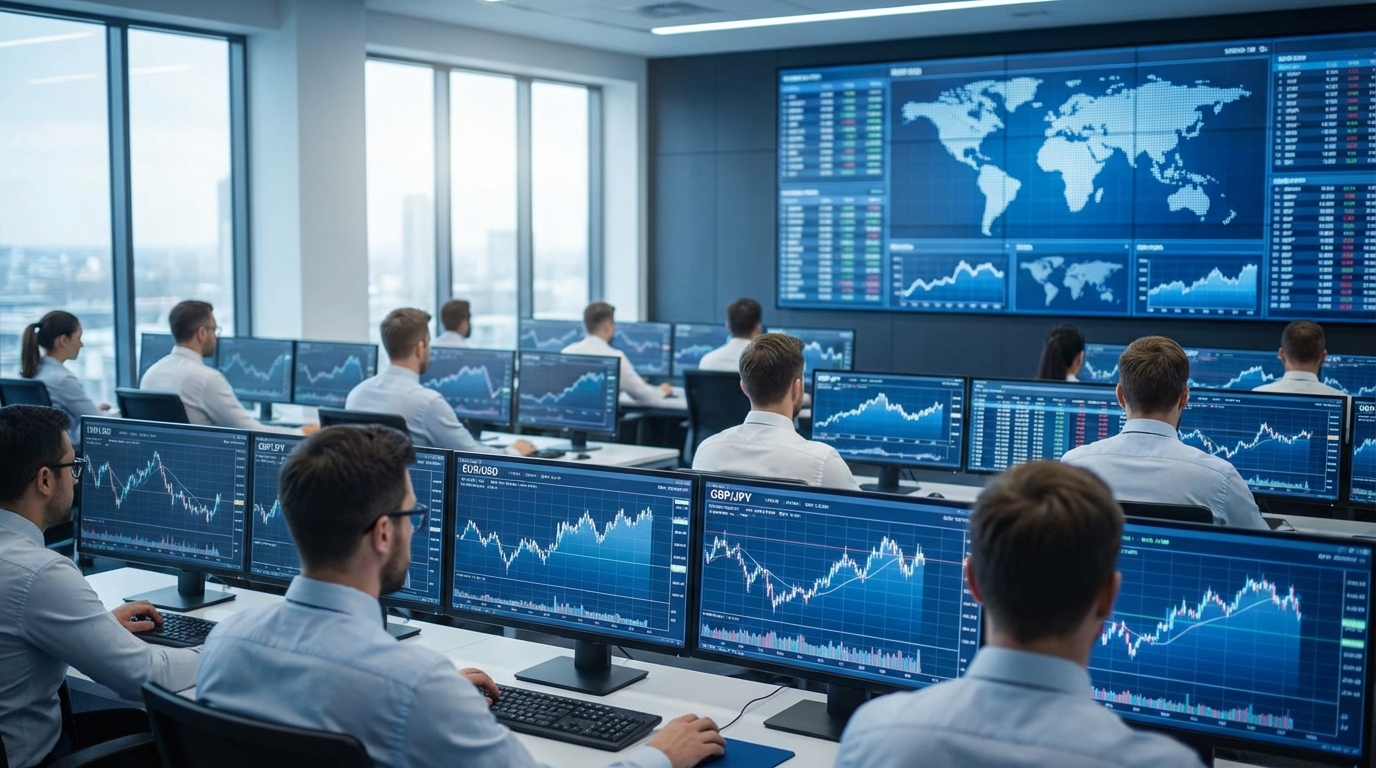
What is the Foreign Exchange Market?
The Foreign Exchange Market, commonly known as Forex or FX, is the largest and most liquid financial market in the world. It is a global, decentralized over-the-counter (OTC) market where all the world's currencies are traded. Unlike a stock exchange, there is no central marketplace for forex; instead, transactions are conducted electronically between banks, institutions, and individual traders across the globe.
The primary purpose of the forex market is to facilitate international trade and investment by enabling currency conversion. When a company in the United States wants to import goods from Europe, they need to exchange U.S. Dollars (USD) for Euros (EUR) to pay their supplier. Similarly, a tourist traveling abroad needs to convert their domestic currency into the local currency of their destination.
However, currency exchange is not solely for practical purposes. A significant portion of the forex market activity, estimated to be over 90%, is speculative. Traders and institutions buy and sell currencies with the aim of profiting from fluctuations in exchange rates. This speculation contributes significantly to the market's immense liquidity.
Key Takeaway: The Bank for International Settlements (BIS) Triennial Central Bank Survey of Foreign Exchange and Over-the-Counter (OTC) Derivatives Markets reported that average daily turnover in global foreign exchange markets reached $7.5 trillion in April 2022, up from $6.6 trillion in April 2019. This highlights the unparalleled scale and liquidity of the forex market.
Key Characteristics of the Forex Market:
- Decentralized: There is no physical exchange like the New York Stock Exchange. Trading occurs electronically across a network of banks, brokers, and other financial institutions.
- 24/5 Operation: The market operates 24 hours a day, five days a week, from Sunday evening GMT to Friday evening GMT. This continuous operation is due to the sequential opening and closing of major financial centers around the world, starting with Sydney, then Tokyo, London, and finally New York.
- High Liquidity: Its enormous size ensures high liquidity, meaning assets can be bought or sold quickly without significantly impacting their price. This makes it easier for traders to enter and exit positions.
- Accessibility: While traditionally dominated by large financial institutions, the rise of online forex brokers has made the market accessible to retail traders with relatively small capital.
How Forex Trading Works
Forex trading involves simultaneously buying one currency and selling another. Currencies are always traded in "pairs." The value of one currency is always expressed in relation to another. For example, EUR/USD refers to the exchange rate between the Euro and the U.S. Dollar.
Currency Pairs: Base and Quote Currencies
Every currency pair consists of two currencies:
- Base Currency: The first currency in the pair (e.g., EUR in EUR/USD). It is the currency you are buying or selling.
- Quote (or Counter) Currency: The second currency in the pair (e.g., USD in EUR/USD). It is the currency used to express the value of the base currency.
When you see a quote like EUR/USD = 1.0850, it means that 1 Euro can be exchanged for 1.0850 U.S. Dollars. If you believe the Euro will strengthen against the U.S. Dollar, you would "buy" the EUR/USD pair. Conversely, if you expect the Euro to weaken, you would "sell" the EUR/USD pair.
Bid and Ask Prices
Forex quotes are always presented with two prices:
- Bid Price: This is the price at which your broker is willing to buy the base currency from you (i.e., you can sell the base currency). It's always slightly lower than the ask price.
- Ask Price (or Offer Price): This is the price at which your broker is willing to sell the base currency to you (i.e., you can buy the base currency). It's always slightly higher than the bid price.
The difference between the bid and ask price is known as the spread, which is one of the primary costs of trading (discussed in detail later).
Example: If EUR/USD is quoted as 1.0850 / 1.0852:
- You can sell 1 Euro for 1.0850 U.S. Dollars (Bid).
- You can buy 1 Euro for 1.0852 U.S. Dollars (Ask).
Going Long or Short
- Going Long (Buying): When you "buy" a currency pair, you are speculating that the value of the base currency will increase relative to the quote currency. For example, buying EUR/USD means you expect the Euro to strengthen against the U.S. Dollar.
- Going Short (Selling): When you "sell" a currency pair, you are speculating that the value of the base currency will decrease relative to the quote currency. For example, selling EUR/USD means you expect the Euro to weaken against the U.S. Dollar.
Profit and Loss
The profit or loss from a forex trade is determined by the difference between the price at which you opened the trade and the price at which you closed it. If you bought EUR/USD at 1.0852 and sold it later at 1.0902, you would make a profit. If you sold it at 1.0802, you would incur a loss.
It's crucial to understand that when you trade forex, you are not physically receiving or delivering currency. Instead, you are entering into a contract for difference (CFD) with your broker, speculating on price movements.
Market Structure and Participants
The forex market operates on a multi-tiered, decentralized structure. There isn't a single exchange, but rather a network of financial institutions connected electronically. This tiered structure ensures liquidity and efficiency across different participant levels.
The Tiered Structure of the Forex Market:
- The Interbank Market (Tier 1):
- At the top are the largest commercial banks (e.g., Citi, JP Morgan, Deutsche Bank, HSBC, UBS, Barclays). These banks trade directly with each other in massive volumes, forming the core of the forex market.
- They provide liquidity to the entire market and determine the bid/ask spreads that filter down to other participants.
- This market is highly competitive and characterized by very tight spreads.
- Institutions and Large Corporations (Tier 2):
- This tier includes smaller banks, multinational corporations, hedge funds, investment management firms, and pension funds.
- They access the interbank market indirectly through Tier 1 banks or Electronic Communication Networks (ECNs) that aggregate prices from multiple liquidity providers.
- These participants trade for hedging purposes (corporations managing currency risk), investment, or speculative purposes.
- Retail Traders (Tier 3):
- Individual traders access the forex market through retail forex brokers.
- Brokers act as intermediaries, either by taking the opposite side of a client's trade (market makers) or by passing client orders directly to larger liquidity providers (ECN/STP brokers).
- This tier has grown significantly with the advent of online trading platforms, making forex accessible to a broader audience.
Key Participants and Their Roles:
- Commercial Banks: These are the backbone of the forex market. They conduct transactions for their clients (corporations, institutions) and engage in proprietary trading to profit from currency fluctuations. They are the primary liquidity providers.
- Central Banks: Institutions like the Federal Reserve (U.S.), European Central Bank (ECB), and Bank of England (BoE) play a crucial role. They manage national currencies, implement monetary policy (e.g., setting interest rates), and may intervene in the forex market to stabilize their currency or achieve specific economic objectives.
- Multinational Corporations: Companies engaged in international trade and business use the forex market to convert currencies for payments, repatriate foreign profits, and hedge against currency risk associated with their global operations.
- Investment Management Firms & Hedge Funds: These entities manage large portfolios of assets for clients or investors. They use forex for diversification, hedging currency exposure in international investments, and actively speculating on currency movements to generate returns.
- Retail Forex Brokers: These firms provide trading platforms and services to individual traders, allowing them to participate in the forex market with relatively small capital. They bridge the gap between retail traders and the larger liquidity providers.
- Retail Traders: Individuals who trade forex for speculative purposes, aiming to profit from short-term or long-term currency price movements. They represent a growing segment of the market.
Key Takeaway: The BIS survey also highlights that the largest share of forex turnover (around 47%) comes from inter-dealer trading, emphasizing the dominance of large banks in the market's core. "Other financial institutions" (hedge funds, institutional investors, etc.) account for about 30%, while "non-financial customers" (corporations) make up roughly 9%.
Understanding Pips, Lots, and Leverage
To effectively trade forex, it's essential to understand the fundamental units of measurement and concepts that dictate position sizing, profit/loss calculation, and risk.
Pips (Percentage in Point)
A pip, or "percentage in point," is the smallest unit of price movement in a currency pair. For most currency pairs, a pip is the fourth decimal place (0.0001). However, for Japanese Yen (JPY) pairs, a pip is the second decimal place (0.01).
- Example (Non-JPY Pair): If EUR/USD moves from 1.0850 to 1.0851, that is a 1-pip movement. If it moves from 1.0850 to 1.0870, that's a 20-pip movement.
- Example (JPY Pair): If USD/JPY moves from 145.20 to 145.21, that is a 1-pip movement.
The value of a pip depends on the currency pair, the size of your trade (lot size), and the exchange rate. To calculate the monetary value of a pip:
Pip Value = (0.0001 / Exchange Rate of Quote Currency to USD) * Lot Size
More simply, for a standard lot (100,000 units) where the USD is the quote currency (e.g., EUR/USD), 1 pip is typically worth $10. For a mini lot (10,000 units), it's $1, and for a micro lot (1,000 units), it's $0.10.
Example: For EUR/USD, if you trade 1 standard lot (100,000 EUR):
- A 1-pip movement (0.0001) in your favor would result in a profit of $10.
- A 10-pip movement in your favor would result in a profit of $100.
Lots
A lot is a standardized unit of currency that specifies the amount of base currency being traded. Since currency movements in pips are very small, traders need to trade large amounts of currency to see significant profits or losses. There are typically three main types of lots:
- Standard Lot: 100,000 units of the base currency. For EUR/USD, this means 100,000 Euros.
- Mini Lot: 10,000 units of the base currency. For EUR/USD, this means 10,000 Euros.
- Micro Lot: 1,000 units of the base currency. For EUR/USD, this means 1,000 Euros.
- Nano Lot: 100 units of the base currency (less common, but offered by some brokers).
The lot size you choose directly impacts the pip value and, consequently, your potential profit or loss. Trading with smaller lot sizes (mini or micro) allows traders to manage risk more effectively, especially with smaller trading accounts.
Example of Pip Value per Lot Size (USD as Quote Currency):
- Standard Lot (100,000 units): ~$10 per pip
- Mini Lot (10,000 units): ~$1 per pip
- Micro Lot (1,000 units): ~$0.10 per pip
Leverage
Leverage in forex trading allows you to control a large amount of money with a relatively small amount of your own capital. It's essentially a loan provided by your broker. Leverage is expressed as a ratio, such as 1:50, 1:100, or even 1:500.
How Leverage Works:
- If you have 1:100 leverage, it means for every $1 of your own capital, you can control $100 in the market.
- To open a position, you only need to put up a small percentage of the total trade value, known as margin.
Example: You want to trade 1 standard lot of EUR/USD (100,000 Euros). If your broker offers 1:100 leverage:
- The total value of the trade is $100,000 (assuming EUR/USD is around 1.00).
- The required margin would be $100,000 / 100 = $1,000.
- So, with just $1,000 in your account, you can control a position worth $100,000.
Important Note: While leverage can magnify profits, it also magnifies losses. High leverage can quickly deplete a trading account if the market moves against your position. Regulators in various jurisdictions (e.g., ESMA in Europe, NFA in the U.S.) have imposed restrictions on the maximum leverage available to retail traders to protect them from excessive risk.
Margin and Margin Call
- Margin: The amount of money required in your trading account to open and maintain a leveraged position. It's not a cost, but rather a portion of your equity set aside as collateral.
- Free Margin: The amount of equity in your account that is not currently being used as margin for open positions. This is the capital available for new trades or to absorb losses on existing trades.
- Margin Call: If your account equity falls below a certain percentage of the required margin (due to losses on open trades), your broker may issue a "margin call." This typically means you need to deposit more funds to meet the margin requirements, or your broker will automatically close some or all of your open positions to prevent further losses and protect their loan.
Understanding and managing leverage is critical for effective risk management in forex trading. It's often recommended to use lower leverage, especially for beginners, to avoid significant losses.
Spreads and Trading Costs
While forex trading can be attractive due to its high liquidity and 24/5 access, it's crucial to understand the costs involved. These costs directly impact your profitability and should be factored into any trading strategy.
The Spread
The spread is the most fundamental cost in forex trading. It is the difference between the bid price (the price you can sell at) and the ask price (the price you can buy at) for a currency pair. When you open a trade, you immediately start at a slight loss equal to the spread because you buy at the higher ask price and would immediately sell at the lower bid price.
- Broker's Profit: The spread is essentially how your broker makes money on your trades.
- Variable vs. Fixed Spreads:
- Variable Spreads: These spreads fluctuate based on market conditions, liquidity, and volatility. They tend to be narrower during high liquidity periods (e.g., London and New York sessions) and widen during low liquidity times (e.g., Asian session overlap with weekend close) or during major news events. Most ECN/STP brokers offer variable spreads.
- Fixed Spreads: Some brokers offer fixed spreads, meaning the difference between the bid and ask price remains constant regardless of market conditions. While this offers predictability, fixed spreads are generally wider than the average variable spread, and brokers offering them are typically market makers.
- Impact of Liquidity and Volatility: Higher liquidity generally leads to tighter spreads, as there are more buyers and sellers. Conversely, low liquidity or high volatility (e.g., during major economic announcements) can cause spreads to widen significantly.
Example: If EUR/USD has a bid of 1.0850 and an ask of 1.0852, the spread is 2 pips (1.0852 - 1.0850 = 0.0002). If you open a 1 standard lot position, this 2-pip spread would cost you $20 (2 pips x $10/pip).
Commissions
While spreads are the primary cost for most retail traders, some brokers, particularly ECN (Electronic Communication Network) or STP (Straight Through Processing) brokers, charge a commission per trade. This is often in addition to very tight (sometimes near-zero) variable spreads.
- How it Works: Commissions are typically charged per standard lot (or a fraction thereof) for opening and closing a trade. For example, a broker might charge $7 per standard lot round turn (meaning $3.50 to open and $3.50 to close).
- Why Choose Commission-Based Brokers: Traders seeking the tightest possible spreads, often high-volume or algorithmic traders, prefer ECN/STP brokers with commissions because the overall trading cost can be lower than with wider spread-only brokers, especially during active market hours.
Swap/Rollover Fees (Interest Rates)
When you hold a forex position open overnight, you may incur or earn a swap fee, also known as a rollover interest. This is because every currency trade involves borrowing one currency to buy another, and each currency has an associated interest rate.
- Interest Rate Differential: The swap fee is based on the interest rate differential between the two currencies in the pair.
- Positive Swap: If you buy a currency with a higher interest rate and sell a currency with a lower interest rate, you might earn interest (a positive swap).
- Negative Swap: If you buy a currency with a lower interest rate and sell a currency with a higher interest rate, you will pay interest (a negative swap).
- Triple Swap on Wednesday: Most brokers apply a triple swap charge/credit on Wednesday nights to account for the settlement of trades over the upcoming weekend.
Swap fees can significantly impact the profitability of long-term trades, so it's essential to be aware of them if you plan to hold positions for more than a day.
Other Potential Costs
- Inactivity Fees: Some brokers charge a fee if your account remains inactive for an extended period (e.g., 3-6 months).
- Deposit/Withdrawal Fees: While many reputable brokers offer free deposits and withdrawals for common methods, some may charge fees for specific payment methods or if you make frequent withdrawals.
- Currency Conversion Fees: If your trading account is denominated in a different currency than your deposit currency, you might incur conversion fees.
Always review your broker's fee schedule and terms and conditions carefully to understand all potential trading and non-trading costs.
Getting Started with Forex
Embarking on your forex trading journey requires preparation, education, and a disciplined approach. Here’s a structured guide to help you begin.
1. Comprehensive Education
Forex trading is not a get-rich-quick scheme. It requires a deep understanding of market dynamics, economic principles, and technical analysis. Dedicate time to learning before risking any capital.
- Fundamentals: Understand macroeconomics, central bank policies, interest rates, inflation, and how these factors influence currency values.
- Technical Analysis: Learn about chart patterns, indicators, support/resistance levels, trend lines, and how to interpret price action.
- Risk Management: This is arguably the most critical aspect. Learn about position sizing, stop-loss orders, take-profit orders, and how to protect your capital.
- Trading Psychology: Understand the emotional challenges of trading and develop mental fortitude to stick to your plan.
2. Choose a Reputable Forex Broker
Selecting the right broker is paramount for a secure and efficient trading experience. Consider the following factors:
- Regulation: Ensure the broker is regulated by a reputable financial authority in a recognized jurisdiction (e.g., FCA in the UK, CySEC in Cyprus, ASIC in Australia, NFA/CFTC in the US). Regulation provides a layer of protection for your funds.
- Spreads and Commissions: Compare the trading costs across different brokers. Look for competitive spreads and transparent commission structures.
- Trading Platforms: Most brokers offer popular platforms like MetaTrader 4 (MT4) or MetaTrader 5 (MT5), cTrader, or their proprietary platforms. Ensure the platform is user-friendly, stable, and offers the tools you need.
- Customer Support: Good customer service is crucial, especially for beginners. Check their availability, responsiveness, and communication channels.
- Account Types: Brokers offer various account types (e.g., Standard, ECN, Micro). Understand the differences and choose one that suits your capital and trading style.
- Funding Options: Check for convenient and secure deposit and withdrawal methods.
3. Start with a Demo Account
Before trading with real money, practice extensively with a demo account. A demo account simulates real market conditions but uses virtual money, allowing you to:
- Familiarize yourself with the trading platform.
- Test different trading strategies without financial risk.
- Understand how orders are placed and executed.
- Develop confidence and discipline.
Treat your demo account seriously, as if it were real money, to build effective trading habits.
4. Develop a Trading Plan
A well-defined trading plan is your roadmap for success. It should outline every aspect of your trading activity:
- Strategy: What market conditions will you trade? What entry and exit signals will you use? Will you focus on fundamental or technical analysis, or a combination?
- Risk Management: How much capital will you risk per trade (e.g., 1-2% of your account)? What is your maximum daily/weekly loss limit? Where will you place your stop-loss and take-profit orders?
- Currency Pairs: Which pairs will you focus on? It's often better to specialize in a few pairs initially.
- Trading Schedule: When will you trade? Which market sessions?
- Goals: What are your realistic profit targets and drawdown limits?
- Journaling: Commit to keeping a trading journal to record your trades, analyze your performance, and identify areas for improvement.
5. Implement Robust Risk Management
This cannot be overstated. Protecting your capital is more important than chasing profits, especially in the volatile forex market.
- Position Sizing: Calculate your position size based on your risk tolerance and account equity, not just on how much you want to win.
- Stop-Loss Orders: Always use stop-loss orders to limit potential losses on a trade. This automatically closes your position if the price moves against you to a predetermined level.
- Never Over-Leverage: While leverage can amplify gains, it also amplifies losses. Use leverage cautiously and understand the margin requirements.
- Only Risk Capital You Can Afford to Lose: Never trade with money essential for your living expenses or financial security.
6. Start Small and Be Patient
When you transition to a live account, start with micro or mini lots and a small amount of capital. Focus on consistently executing your trading plan and managing risk, rather than aiming for large, quick profits. Trading success is a marathon, not a sprint, and requires continuous learning, adaptation, and discipline.
Disclaimer: Trading foreign exchange on margin carries a high level of risk and may not be suitable for all investors. The high degree of leverage can work against you as well as for you. Before deciding to trade foreign exchange, you should carefully consider your investment objectives, level of experience, and risk appetite. The possibility exists that you could sustain a loss of some or all of your initial investment and therefore you should not invest money that you cannot afford to lose. You should be aware of all the risks associated with foreign exchange trading and seek advice from an independent financial advisor if you have any doubts.