
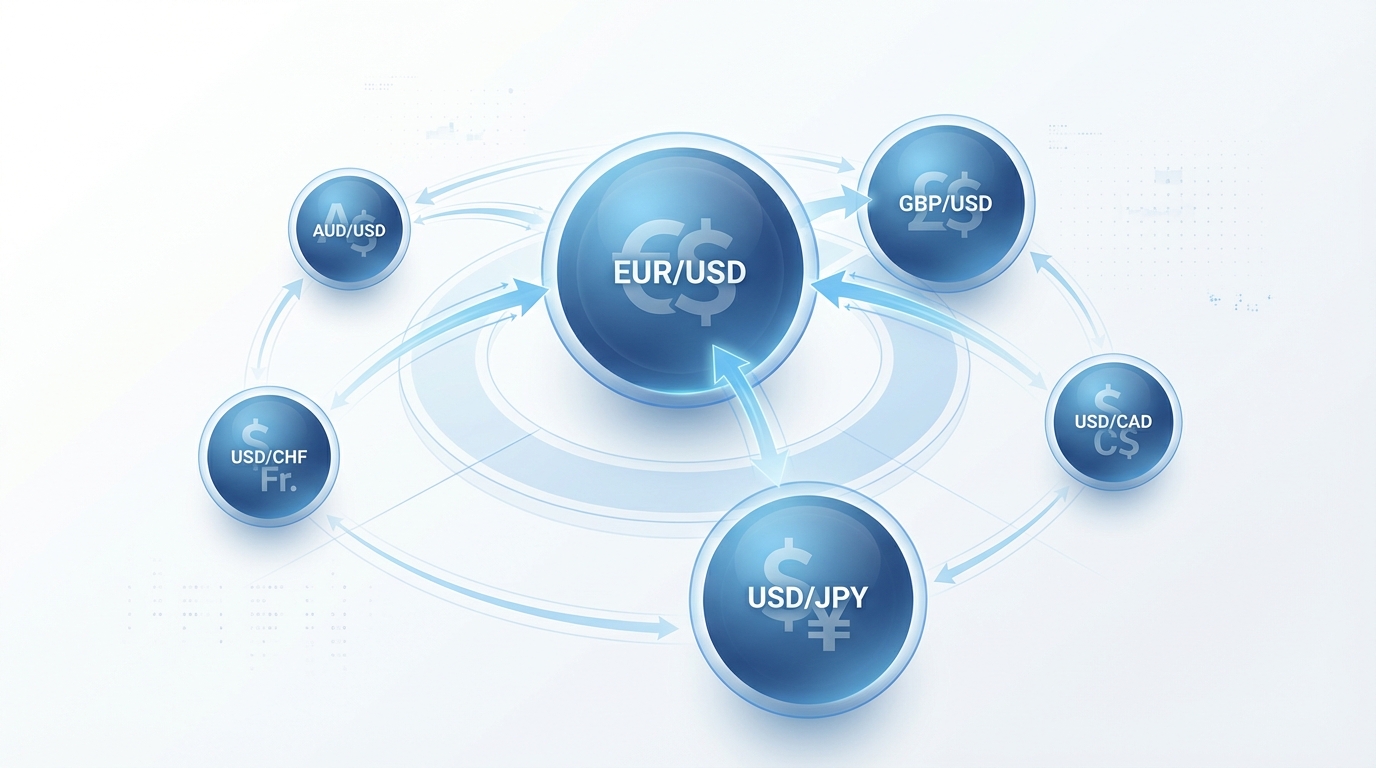
What are Currency Pairs?
At the heart of the foreign exchange (forex) market lies the currency pair, the fundamental unit of trading. Unlike stock trading where an investor buys or sells shares of a single company, forex trading always involves the simultaneous buying of one currency and selling of another. This creates a pair, such as EUR/USD or USD/JPY.
A currency pair consists of two components:
- Base Currency: The first currency listed in the pair. It is the currency that is being bought or sold.
- Quote (or Counter) Currency: The second currency listed. It is the currency used to express the value of the base currency.
For example, in the pair EUR/USD, the Euro (EUR) is the base currency, and the US Dollar (USD) is the quote currency. If the exchange rate for EUR/USD is 1.1000, it means that 1 Euro can be exchanged for 1.1000 US Dollars. When you buy EUR/USD, you are buying Euros and simultaneously selling US Dollars. Conversely, when you sell EUR/USD, you are selling Euros and simultaneously buying US Dollars.
Key Takeaway: Currency pairs express the value of one currency in terms of another. The base currency is always valued at one unit, and the quote currency indicates how much of it is needed to equal one unit of the base currency.
The price of a currency pair is always quoted with two values: the bid price and the ask price. The bid price is the price at which a trader can sell the base currency, while the ask price (or offer price) is the price at which a trader can buy the base currency. The difference between the bid and ask price is known as the spread, which represents the cost of executing a trade.
Price movements in currency pairs are typically measured in pips (percentage in point). A pip is the smallest unit of price change in a currency pair, usually the fourth decimal place (e.g., 0.0001) for most pairs, except for Japanese Yen pairs where it's the second decimal place (e.g., 0.01).
Major Currency Pairs
Major currency pairs are the most frequently traded pairs in the global forex market. They are characterized by their exceptional liquidity, high trading volume, and relatively tight spreads, making them attractive to a vast array of market participants, from retail traders to large institutional investors. These pairs invariably involve the US Dollar (USD) paired with another major global currency from the G10 group of industrialized nations.
The dominance of major pairs is evident in their market share. According to the Bank for International Settlements (BIS) Triennial Central Bank Survey of Foreign Exchange and Over-the-counter (OTC) Derivatives Markets, the US Dollar was on one side of 88% of all foreign exchange transactions in 2022. The major pairs collectively account for over 80% of the total daily forex trading volume.
The seven primary major currency pairs are:
- EUR/USD (Euro / US Dollar): Often referred to as "Fiber," this is the most traded currency pair globally, reflecting the economic might of the Eurozone and the United States. Its movements are influenced by interest rate differentials between the European Central Bank (ECB) and the Federal Reserve (Fed), GDP growth, inflation data, and political stability in both regions.
- USD/JPY (US Dollar / Japanese Yen): Known as "Gopher," this pair represents the second-largest trading volume. The Japanese Yen is often considered a safe-haven currency, particularly during times of global economic uncertainty. It is also a popular choice for carry trades due to Japan's historically low interest rates. Key drivers include monetary policy divergence between the Fed and the Bank of Japan (BOJ), risk sentiment, and trade balances.
- GBP/USD (Great British Pound / US Dollar): Dubbed "Cable" (a reference to the transatlantic telegraph cable that once transmitted prices), this pair connects two of the oldest and most significant financial centers: London and New York. It is known for its volatility and sensitivity to UK economic data (e.g., inflation, employment, GDP) and Bank of England (BOE) monetary policy, as well as geopolitical developments.
- USD/CHF (US Dollar / Swiss Franc): The "Swissie" is another safe-haven currency, often sought during periods of market stress due to Switzerland's political neutrality and strong banking sector. The Swiss National Bank (SNB) is known for its interventionist monetary policy. This pair often exhibits an inverse correlation with EUR/USD, though not always perfectly.
- AUD/USD (Australian Dollar / US Dollar): Referred to as "Aussie," this is a prominent commodity currency. Australia is a major exporter of raw materials (e.g., iron ore, coal, gold), so the AUD is highly sensitive to global commodity prices, particularly those from China, its largest trading partner. Reserve Bank of Australia (RBA) interest rate decisions and global risk appetite are also significant drivers.
- USD/CAD (US Dollar / Canadian Dollar): Known as "Loonie" (after the bird on the Canadian dollar coin), this is another commodity currency, heavily influenced by crude oil prices due to Canada's status as a major oil producer. Bank of Canada (BOC) monetary policy and economic data (e.g., employment, inflation) also play a crucial role.
- NZD/USD (New Zealand Dollar / US Dollar): The "Kiwi" is also a commodity currency, though its drivers are more related to agricultural exports (dairy, meat) and tourism. It shares some characteristics with AUD/USD but can also diverge based on specific New Zealand economic performance and Reserve Bank of New Zealand (RBNZ) policy.
The high liquidity of these pairs ensures that orders can be filled quickly and efficiently, even for large volumes, with minimal price slippage. Their tight spreads mean lower transaction costs, which is particularly beneficial for high-frequency traders. Furthermore, the economies underlying these currencies are well-researched, with abundant economic data and news readily available, enabling comprehensive fundamental analysis.
Minor Currency Pairs (Crosses)
Minor currency pairs, often referred to as "crosses" or "cross-currency pairs," are those that do not include the US Dollar. While they might not boast the same colossal trading volumes as the majors, they still represent a significant portion of the forex market and offer unique trading opportunities.
The term "cross" originated from a time when trading between two non-USD currencies required two separate transactions, effectively using the USD as an intermediary. For instance, to trade EUR against JPY, one would first convert EUR to USD, and then USD to JPY. Modern electronic trading platforms eliminate this need, allowing direct exchange, but the "cross" moniker has persisted.
Minor pairs typically involve combinations of the other major currencies (EUR, JPY, GBP, CHF, AUD, CAD, NZD). Some common examples include:
- EUR/GBP: The Euro against the British Pound. This pair is highly sensitive to economic developments in the Eurozone and the UK, as well as monetary policy decisions from the ECB and BOE.
- EUR/JPY: The Euro against the Japanese Yen. This pair is often influenced by risk sentiment (JPY as a safe haven) and interest rate differentials between the Eurozone and Japan.
- GBP/JPY: The British Pound against the Japanese Yen. Known as "Geppy" or "Guppy," this pair is one of the most volatile crosses, often exhibiting large price swings due to the combination of GBP's inherent volatility and JPY's safe-haven characteristics.
- AUD/JPY: The Australian Dollar against the Japanese Yen. This pair is a classic carry trade candidate due to Australia's relatively higher interest rates and Japan's low rates, but it is also sensitive to commodity prices and global risk appetite.
- CHF/JPY: The Swiss Franc against the Japanese Yen. Two prominent safe-haven currencies, this pair's movements often reflect global risk-off sentiment or specific policy actions by the SNB and BOJ.
- EUR/CHF: The Euro against the Swiss Franc. This pair has historically been a focal point for SNB intervention to manage the strength of the Swiss Franc against the Euro.
Characteristics of minor currency pairs:
- Lower Liquidity: Compared to major pairs, crosses generally have lower trading volumes and thus less liquidity. This can lead to wider bid-ask spreads, which translates to higher transaction costs.
- Higher Volatility: While not universally true, many minor pairs can exhibit higher volatility than majors, especially when significant economic data or geopolitical events impact one of the constituent currencies.
- Unique Drivers: Their movements are often driven by the relative economic performance and monetary policy divergences between the two non-USD economies involved. This can offer distinct trading opportunities not found in major pairs.
- Diversification: Trading minor pairs can provide diversification to a portfolio dominated by major pairs, potentially reducing overall portfolio correlation.
- Sensitivity to Regional News: They can be more acutely sensitive to specific regional economic reports, political developments, or central bank statements from the economies they represent.
While minor pairs require a deeper understanding of the individual economies and their interrelationships, they can offer compelling opportunities for traders seeking to capitalize on specific economic trends or interest rate differentials that might not be as pronounced in the major pairs.
Exotic Currency Pairs
Exotic currency pairs represent a segment of the forex market that involves one major currency (typically the US Dollar) paired with a currency from a smaller or emerging market (EM) economy. These pairs are at the opposite end of the liquidity spectrum compared to major pairs and even crosses.
Examples of exotic currency pairs include:
- USD/MXN (US Dollar / Mexican Peso)
- EUR/TRY (Euro / Turkish Lira)
- USD/ZAR (US Dollar / South African Rand)
- USD/SGD (US Dollar / Singapore Dollar)
- USD/HKD (US Dollar / Hong Kong Dollar)
- USD/PLN (US Dollar / Polish Zloty)
- GBP/HUF (British Pound / Hungarian Forint)
Characteristics of exotic currency pairs:
- Significantly Lower Liquidity: Trading volumes for exotic pairs are considerably lower than majors and minors. This means fewer buyers and sellers in the market at any given time.
- Much Wider Spreads: Due to low liquidity, brokers typically quote much wider bid-ask spreads for exotic pairs. This significantly increases transaction costs and can make them less suitable for short-term or high-frequency trading strategies.
- Higher Volatility: Exotic currencies are often subject to pronounced and sudden price swings. This volatility can stem from political instability, rapid economic changes, commodity price fluctuations (for commodity-exporting EMs), changes in investor sentiment towards emerging markets, or capital controls imposed by governments.
- Higher Interest Rate Differentials: Emerging market economies often maintain higher interest rates to attract foreign capital and combat inflation. This can make exotics attractive for carry trade strategies, but the potential for higher returns is always accompanied by significantly elevated risk.
- Limited Data and News Availability: Information and analysis on emerging market economies may not be as readily available or as comprehensive as for major economies. This can make fundamental analysis more challenging.
- Specific Market Nuances: Some exotic pairs may have specific trading hours, particular regulatory environments, or be subject to direct intervention by their respective central banks.
Caution: While exotic pairs offer the potential for substantial gains due to their volatility and interest rate differentials, they also carry significantly higher risks. The wider spreads, lower liquidity, and susceptibility to sudden, unpredictable events make them more challenging to trade effectively, especially for inexperienced traders.
Traders who venture into exotics often do so with a deep understanding of the underlying economic and political landscape of the emerging market country. They might be looking to capitalize on long-term trends, specific policy changes, or significant shifts in global capital flows.
Currency Correlations
Currency correlation refers to the statistical relationship between two currency pairs, indicating how likely they are to move in the same direction, opposite directions, or with no discernible relationship. Understanding currency correlations is a critical aspect of risk management and strategy development for forex traders.
Correlation is typically measured using a coefficient that ranges from -1 to +1:
- +1 (Perfect Positive Correlation): The two currency pairs move in the exact same direction 100% of the time.
- -1 (Perfect Negative Correlation): The two currency pairs move in the exact opposite direction 100% of the time.
- 0 (No Correlation): There is no predictable relationship between the movements of the two currency pairs.
In practice, perfect correlations (+1 or -1) are rare. Most correlations are somewhere in between, and importantly, they are dynamic – they can change over time due to shifts in economic conditions, geopolitical events, or central bank policies.
Examples of Common Correlations:
- Positive Correlation (e.g., EUR/USD and GBP/USD): Both the Eurozone and the UK have strong economic ties with the US and each other. Since both pairs have the USD as the quote currency, and their base currencies (EUR, GBP) often react similarly to global events or USD strength/weakness, they tend to move in the same direction. If EUR/USD rises, GBP/USD often rises too.
- Negative Correlation (e.g., EUR/USD and USD/CHF): The US Dollar is the base currency in USD/CHF but the quote currency in EUR/USD. The Swiss Franc (CHF) is also often considered a safe-haven currency that can strengthen when the USD weakens. Consequently, when EUR/USD rises (USD weakens), USD/CHF often falls (USD weakens against CHF).
- Commodity Correlations (e.g., AUD/USD and Gold; USD/CAD and Oil):
- Australia is a major gold producer, so the AUD/USD often shows a positive correlation with gold prices. When gold rises, AUD/USD tends to rise.
- Canada is a significant oil exporter, so the USD/CAD often shows a strong negative correlation with crude oil prices. When oil prices rise, the CAD strengthens, causing USD/CAD to fall.
Implications for Traders:
- Risk Management: Trading highly correlated pairs in the same direction can inadvertently increase exposure to a single risk factor. For example, if a trader buys both EUR/USD and GBP/USD, they are essentially doubling down on a positive outlook for EUR/GBP and a negative outlook for USD. If the USD strengthens unexpectedly, both positions could incur losses.
- Diversification: Identifying uncorrelated or negatively correlated pairs can help diversify a trading portfolio and potentially smooth out returns by offsetting losses in one position with gains in another.
- Confirmation: Traders might use correlated pairs to confirm trade signals. If a technical setup suggests buying EUR/USD, and a positively correlated pair like GBP/USD shows a similar setup, it can add conviction to the trade.
- Hedging Strategies: Negatively correlated pairs can be used for hedging. If a trader holds a long position in one pair and fears a potential downturn, they might take a smaller long position in a negatively correlated pair to mitigate potential losses.
- Arbitrage Opportunities: While less common for retail traders, significant deviations from historical correlations can sometimes signal short-term arbitrage opportunities.
It is crucial for traders to regularly monitor currency correlations as they are not static. Economic data releases, central bank policy shifts, and global risk sentiment can all influence these relationships over time. Various online tools and platforms provide real-time correlation matrices to assist traders in this analysis.
Choosing Pairs to Trade
The selection of currency pairs to trade is a highly personal decision, heavily influenced by a trader's strategy, risk tolerance, available capital, and market knowledge. There is no universally "best" pair; rather, the optimal choice aligns with individual trading goals and capabilities.
Here are key factors to consider when choosing which currency pairs to trade:
- Liquidity and Spreads:
- Majors: Offer the highest liquidity and tightest spreads, making them ideal for all types of traders, especially those who trade frequently or with larger volumes. Lower transaction costs are a significant advantage.
- Minors: Have moderate liquidity and wider spreads than majors but are still manageable. They can be suitable for traders looking for diversification and specific cross-currency trends.
- Exotics: Characterized by very low liquidity and significantly wider spreads. These are generally not recommended for beginners due to higher transaction costs and potential for slippage.
- Volatility:
- High Volatility: Pairs like GBP/JPY or some exotics offer larger potential price swings, which can be attractive for short-term traders seeking quick profits. However, higher volatility also means higher risk and requires robust risk management.
- Lower Volatility: Some major pairs (e.g., EUR/CHF, though historically it has seen periods of extreme volatility) or during specific market conditions, might exhibit lower volatility, which can be more suitable for longer-term strategies or traders who prefer less dramatic price action.
- Economic Fundamentals:
- Understand the economic drivers behind each currency. Are you comfortable analyzing GDP, inflation, interest rates, employment data, and geopolitical events for the respective economies?
- Major currencies have abundant, easily accessible data. Emerging market currencies (in exotics) can be more challenging to research and understand due to less transparent data or political complexities.
- Technical Analysis Suitability:
- Some pairs tend to exhibit clearer technical patterns (e.g., trend lines, support/resistance levels) than others. This can be due to their liquidity and the presence of institutional trading algorithms.
- Experiment with different pairs to see which ones "respect" technical indicators and chart patterns best for your chosen strategy.
- Trading Hours:
- Liquidity and volatility for a pair are highest when the markets of the constituent currencies are open. For example, GBP/USD is most active during the London and New York sessions.
- Consider your own availability and which trading sessions you can actively monitor.
- Interest Rate Differentials (Carry Trade):
- If your strategy involves carry trades (profiting from interest rate differences), you'll look for pairs with significant positive interest rate differentials, such as AUD/JPY or NZD/JPY. However, this strategy carries its own risks, especially with high-yielding exotic currencies.
- Personal Knowledge and Familiarity:
- It's often best to start with pairs you feel most comfortable researching and understanding. If you live in Europe, you might have a natural inclination or better access to information regarding the Euro.
- Avoid trading too many pairs simultaneously, especially as a beginner. Focus on mastering a few before expanding.
For beginners, starting with the major currency pairs (e.g., EUR/USD, USD/JPY, GBP/USD) is highly recommended. Their high liquidity, tight spreads, and abundant information make them more forgiving for learning and developing trading skills. As experience grows and understanding deepens, traders can gradually explore minor and eventually exotic pairs, always with a heightened awareness of the increased risks involved.
In conclusion, a thorough understanding of the different categories of currency pairs—majors, minors, and exotics—is foundational for any participant in the forex market. Each category presents a unique risk-reward profile, driven by factors such as liquidity, volatility, and underlying economic dynamics. By carefully evaluating these characteristics against one's own trading objectives and risk appetite, traders can make informed decisions about which pairs best align with their strategy, ultimately enhancing their potential for success in this dynamic market.
***
Disclaimer: Trading foreign exchange on margin carries a high level of risk and may not be suitable for all investors. The high degree of leverage can work against you as well as for you. Before deciding to trade foreign exchange, you should carefully consider your investment objectives, level of experience, and risk appetite. The possibility exists that you could sustain a loss of some or all of your initial investment and therefore you should not invest money that you cannot afford to lose. You should be aware of all the risks associated with foreign exchange trading, and seek advice from an independent financial advisor if you have any doubts.